
We may earn money or products from the companies mentioned in this post.

Ask three property managers what they charge and you will likely hear three different answers, each with its own mix of percentages, flat fees and fine print. That is why the question “how much do property managers charge” has no single tidy number. This guide pulls together what industry sources and software vendors publish, runs the numbers on an example rental, and sets the total against three DIY landlord software products.
Most landlords look first at the monthly percentage, because it is the figure every manager quotes up front. It sounds small, it is easy to compare, and it fits in one sentence. The sources reviewed here point to the catch: the monthly percentage is often the smaller part of the total bill, and the larger costs tend to sit in the full fee schedule.
How much do property managers charge? The main fee types and their typical ranges
Managers generally price their work in one of three ways: a percentage of rent, a flat fee, or a per-project fee. Most full-service managers combine them. In practice that usually means a monthly fee for ongoing work, a separate fee each time they place a new tenant, and a list of extras on top.
| Fee | Typical cost | What it covers |
|---|---|---|
| Monthly management fee | 7% to 10% of collected rent (some charge 8% to 10%) | Collecting rent, inspections, maintenance and emergency calls |
| Leasing or tenant placement fee | 75% to 100% of the first month’s rent | Advertising, showings, applications, screening, lease paperwork, move-in prep |
| Lease renewal fee | A flat fee or up to a full month’s rent | Renewing an existing tenant’s lease |
| Vacancy, setup, eviction and other fees | Varies by company | Charged on some contracts; ask for each in writing |
On the monthly fee, Rentec Direct reports that it usually runs 7% to 10% of collected rent, while Mashvisor notes that some companies charge 8% to 10% of monthly rent. The leasing fee, which pays for finding and placing a tenant, is usually 75% to 100% of the first month’s rent.
After those two come possible extras that differ from one company to the next. They include vacancy fees, onboarding or setup fees, a share of late fees, maintenance markups, renewal fees, eviction fees, and in some contracts the manager keeping “other income” such as pet rent.
A word on how strong this evidence is. The fee ranges come from Rentec Direct and Mashvisor, two industry sources, and neither is a national survey. Fees also change by city and by company, so treat every number here as a range to test against real quotes from local managers.
Why “rent collected” or “rent due” changes what the monthly fee costs you
The monthly management fee is the headline number, typically 7% to 10% of collected rent. On a rental that brings in $2,000 a month, that comes to somewhere between $140 and $200 a month.
How the contract words this fee matters more than many owners expect. A percentage of rent collected and a percentage of rent due can produce very different bills.
When a manager charges on rent collected, the owner pays only when money actually arrives. When the fee is based on rent due, the owner could still owe it in a month when the tenant pays late or skips payment entirely.
Before comparing any two quotes, it is worth asking each company one direct question: “Is your percentage calculated on rent collected or rent due?” The answer takes seconds to get and shows how much of the nonpayment risk stays with the owner.
Leasing fees: the charge that can equal months of management
Among all the charges, this one tends to surprise owners most. A leasing fee, also called a tenant placement fee, is usually 75% to 100% of the first month’s rent.
It generally covers advertising the unit, holding showings, taking applications, screening applicants, preparing the lease paperwork and getting the unit ready for move-in.
The fee comes due again each time a new tenant moves in. A rental with a long-term tenant barely registers it, while one with frequent turnover can stack up leasing fees quickly. For a unit that changes tenants every year or so, it effectively becomes a recurring charge on top of the monthly percentage.
That is why total annual cost is a better yardstick than a percentage of rent. Over a full year, one leasing fee can equal several months of management fees, and in a year with turnover it can come close to the whole year’s monthly fees.
The extra fees hidden in many management agreements
Rentec Direct suggests asking about a handful of extras, and each one deserves a line-by-line check in the management agreement (the contract between the owner and the manager).
A vacancy fee means some managers bill the owner even while the unit sits empty, which is exactly when the property earns nothing. An onboarding or setup fee is charged up front to bring the property into the manager’s systems.
A late fee share means the manager keeps part of the late fees tenants pay. This raises a question about incentives as well as cost, since a manager who earns money when tenants pay late may not push for on-time rent with the same urgency the owner would.
Maintenance markups are amounts the manager adds on top of the contractor’s repair bill, and they can be hard to see without reading invoices closely. A lease renewal fee can be a flat amount or a full month’s rent. An eviction fee is often billed separately, so many owners only learn what it costs when they need it.
Some managers also keep other income, such as pet rent or returned-check fees, instead of passing it on to the owner.
Together, these extras explain why a low monthly percentage can hide high add-on costs. A manager advertising 7% with generous extras can end up costing more than one charging 9% with a clean schedule. That is the reason to get the full fee schedule in writing and compare total cost, since the headline percentage alone can mislead.
Running the numbers on a single $2,000 rental
The example below uses round numbers. It is an illustration and not a quote, but it shows how the separate fees add up.
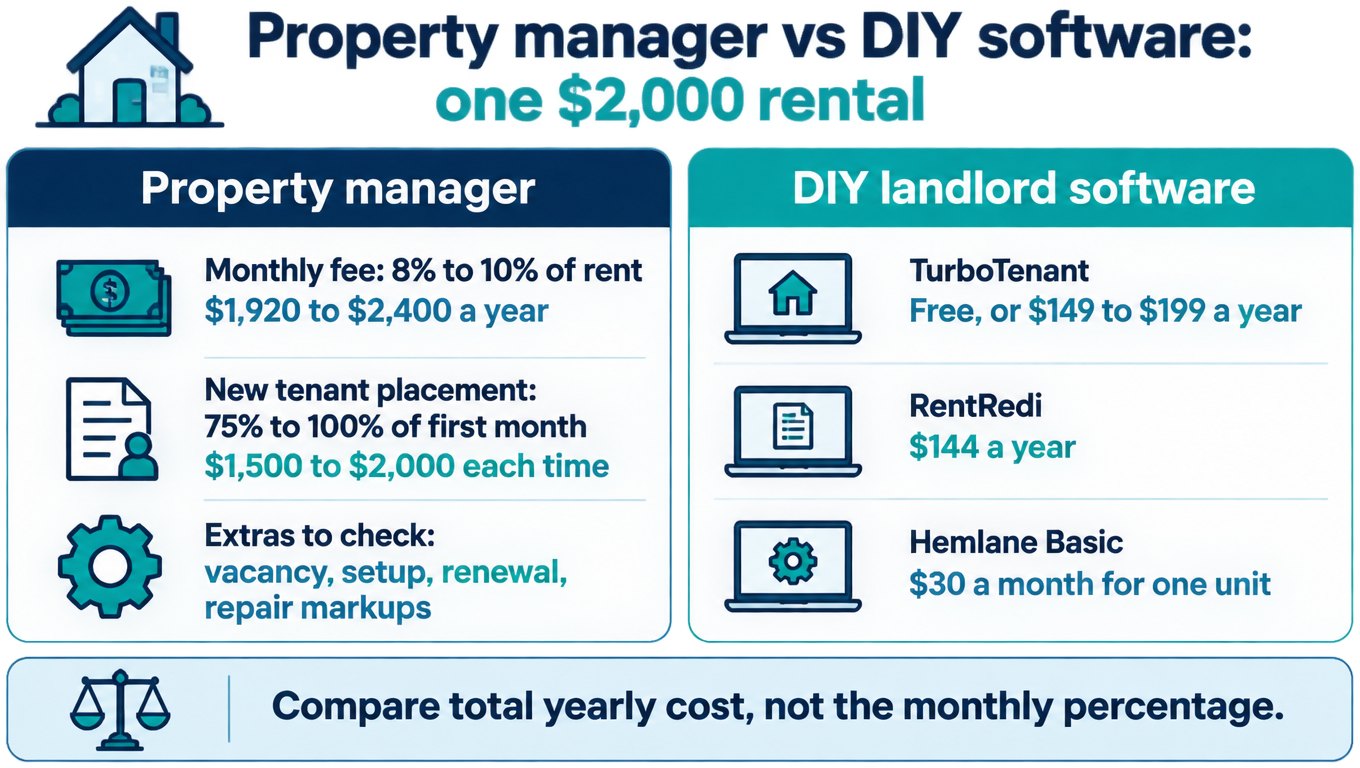
Take one rental at $2,000 a month. At an 8% fee, management costs $160 a month, or $1,920 a year. At 10%, it costs $200 a month, or $2,400 a year.
Next comes the leasing fee. At 75% to 100% of the first month’s rent, placing a new tenant costs $1,500 to $2,000 each time. In a year when a new tenant moves in, that one fee can come close to matching an entire year of monthly management fees.
Many landlords overlook this: the monthly percentage is often the smaller share of the cost. All of these figures also come before any vacancy fee, setup fee, markup, renewal charge or eviction fee, so total annual cost is the figure worth comparing.
What TurboTenant, RentRedi and Hemlane charge landlords
Software sits on the other side of the comparison. It will not take a tenant’s call in the middle of the night, but it does handle listings, tenant screening and rent collection for very little money.
The prices below come from the vendors’ own pricing pages, checked in November 2026. Software pricing changes, so confirm each figure on the vendor’s site before signing up.
| Software | Landlord price | Tenant or applicant pays |
|---|---|---|
| TurboTenant | Free; Essentials $149 a year; Pro $199 a year (1 to 10 units) | On Free: $55 screening, $2 per bank rent payment |
| RentRedi | $144 a year billed annually ($12 a month); $29.95 month to month | $39.99 screening, or $49.99 with an income check |
| Hemlane Basic | Starter free; Basic $2 per unit a month plus a $28 platform fee ($30 a month for one unit, annual billing) | $40 screening; card payments 3%, bank payments free |
Property manager or DIY software: which fits you?
Answer three quick questions to see which option fits your situation.
According to its pricing page, TurboTenant offers a Free plan at $0, an Essentials plan at $149 a year and a Pro plan at $199 a year, covering 1 to 10 units. On the Free plan, screening costs $55 and each bank rent payment costs the tenant $2.
RentRedi sells a single plan that includes all features and unlimited units. It costs $12 a month billed annually, which comes to $144 a year. The same plan is $20 a month on 6-month billing, or $29.95 month to month. Screening is $39.99, or $49.99 with an income check, and the applicant pays it.
Hemlane lists a free Starter plan. Its Basic plan costs $2 per unit a month plus a $28 platform fee, so a single unit comes to $30 a month on annual billing. Screening is $40, paid by the tenant. ACH payments (direct bank transfers) carry no fee, while card payments carry a 3% charge.
Set those prices next to the worked example and the gap is wide. On these plans, DIY software runs from $0 to about $360 a year, while management fees on one $2,000 rental run roughly $1,920 to $2,400 a year before any leasing fee. The cheapest software can cost less per year than a single month of management at 10% on that same rental.
Note that “free” does not always mean free for everyone involved. On free plans, costs like screening and payment fees often shift to the tenant, and that can quietly affect who decides to apply.
Two smaller details matter for owners with few units. Hemlane’s $28 platform fee makes a single unit more expensive per unit than several units would be. And RentRedi‘s “unlimited units” offers little extra value to someone who owns two rentals.
Hybrid plans that pair software with paid help
Between full-service management and pure DIY sits a hybrid option, which can suit owners who want help with one specific task. Hemlane’s higher plans are an example.
On annual billing, with the $28 platform fee included for one unit, the Essential plan costs $20 per unit plus the platform fee, or $48 a month for a single unit. It adds a dedicated repair coordinator, someone who arranges repairs on the owner’s behalf.
The Complete plan costs $58 per unit plus the platform fee, or $86 a month for one unit, and it adds fuller management help.
Hemlane says annual billing saves up to 20%, and it also sells tenant placement starting at $695, including a lockbox fee.
For an owner whose biggest worry is coordinating repairs, a repair coordinator at $48 a month is a very different deal from a manager taking 8% to 10% of all rent. For owners in that position, the overlap between software and a manager is what makes the hybrid plans attractive.
A five-step way to compare a manager with software using your own numbers
The process below relies on an owner’s own figures in place of any company’s marketing.
Step one: put an honest price on your time. Estimate how many hours a rental actually takes each month, counting showings, tenant messages, repair coordination and lease paperwork. Then decide what those hours are worth to you. Hiring a manager amounts to buying back those hours, so the real question is whether the price per hour is fair.
Step two: work out total annual cost. For each manager under consideration, add twelve months of fees, add a realistic number of leasing fees based on how often your units turn over, and add any setup, renewal or markup costs. Repeat the same exercise for software. With both totals in hand, the comparison is like for like.
Step three: collect written quotes. Ask two or three local managers for quotes and insist on the complete fee schedule in writing. Each company structures its fees differently, so the written schedule is what makes a fair comparison possible. Asking whether any fee is negotiable costs nothing.
Step four: look at your own situation. Distance from the property, number of units, knowledge of local law and tolerance for tenant calls all push the answer one way or the other.
Step five: start small if unsure. Trying software first costs little, and hiring a manager later is usually still possible if DIY stops working. That makes software a low-risk trial with no long-term commitment attached.
Situations where paying a property manager tends to make sense
Whether a property manager is worth the cost depends on the owner, and a blanket yes or no from anyone should be treated with suspicion, since it often comes from someone with something to sell.
Hiring tends to make sense for owners with many units, where the small tasks add up; one unit needs a manager far less than ten do. It also makes sense for owners who live far from their rentals, because distance changes the math for out-of-state owners.
Owners who lack time to answer calls and coordinate repairs, or who simply dislike dealing with tenants, are also good candidates. That last reason is perfectly valid, since personal temperament is a real factor.
A first-time landlord who is unsure of local landlord-tenant law is another strong case, because mistakes in that area get expensive. A good manager may also recover part of the fee through better tenant screening and established relationships with contractors. A poor manager can cost more than they save, though, and quality varies enormously.
Situations where DIY landlord software is the better value
DIY software tends to come out ahead for owners with one to a few units close to home who have time to answer calls and arrange repairs. The cost gap is large: software runs $0 to about $360 a year on the plans above, compared with well over a thousand dollars a year for management on a single $2,000 rental.
It helps to be clear about what software does. It handles listings, screening and rent payments, but it will not fix a leaking pipe. The owner still has to be reachable when something breaks.
Calls at odd hours are one of the biggest hidden costs of self-managing, and many owners underestimate how many small tasks even one rental creates. For landlords who are undecided, a hybrid plan or a software trial is a low-cost way to find out which approach suits them.
Questions to ask a property manager before signing the agreement
- Is the monthly fee a percentage of rent collected or rent due?
- What is the leasing fee, and is there a separate renewal fee?
- Is there any charge while the unit is vacant, or a setup fee to start?
- Does the company keep any share of late fees, pet rent or returned-check fees?
- Is a markup added to repair invoices, and who chooses the contractors?
- What is the charge to handle an eviction?
- Who holds the security deposit, and what reports does the owner receive each month?
- How does the owner end the agreement, and what does leaving cost?
Because a manager advertising a low percentage with generous extras can cost more than one charging a higher percentage with a clean schedule, add the answers up into one total.
Common questions about property management fees and landlord software
How much do property managers charge per month?
Most full-service managers charge 7% to 10% of collected rent each month. On a $2,000 rental, that comes to roughly $140 to $200 a month, and some companies charge a flat fee per unit instead.
What is a typical property management fee percentage?
The typical range is 7% to 10% of collected rent, with some companies quoting 8% to 10%. The actual cost depends on the city, the company and the extras in the agreement.
What is a tenant placement fee?
A tenant placement fee, also called a leasing fee, pays for advertising, showings, screening, lease paperwork and move-in prep. It usually runs 75% to 100% of the first month’s rent, and it is charged each time a new tenant moves in.
Is a property manager worth it for one rental?
For one rental close to home, software is usually the better value for an owner with time to handle calls and repairs. A manager makes more sense for an owner who lives far away or wants to avoid tenant contact entirely.
Is property management fee based on rent collected or rent due?
It depends on the contract, and the difference matters. A fee on collected rent applies only when a tenant pays, while a fee on rent due can apply even in a month with no payment.
Do property managers charge when the unit is vacant?
Some do. A vacancy fee is one of the extras to look for in the management agreement, so it is worth asking about before signing.
What is the cheapest landlord software for one unit?
TurboTenant has a Free plan at $0, and Hemlane has a free Starter plan. RentRedi costs $12 a month billed annually. On free plans, screening and payment fees often fall on the tenant.
Leasing fees and total annual cost decide the comparison more than the monthly rate
The monthly percentage is typically 7% to 10% of collected rent, yet it is often the smaller part of what property managers charge, since leasing fees of 75% to 100% of the first month’s rent can rival a full year of monthly fees. Always ask whether the fee applies to rent collected or rent due, and get the complete fee schedule in writing.
DIY software costs roughly $0 to about $360 a year on the plans covered here, which makes it the better value for a few nearby units. Whichever way an owner leans, compare total annual cost, collect written quotes from two or three local managers, and remember that fees vary by city and company.
Sources for the fee ranges and software prices
- Rentec Direct, All You Need To Know About Property Management Fees (checked November 22, 2026)
- Mashvisor, property management fees article (checked November 22, 2026)
- Hemlane pricing page, hemlane.com/pricing (annual billing prices, checked November 22, 2026)
- TurboTenant pricing page, turbotenant.com/pricing (checked November 19 to 21, 2026)
- RentRedi pricing page, rentredi.com/pricing (checked November 21, 2026)
Fees vary by city and company, and this article is general information, not legal or financial advice.